
Trusted Agents for
Supply Chains
Prometheux helps supply chain leaders keep goods moving through disruption, balance stock against cash and deliver on time, with AI that runs your own rules on the ERP, supplier, inventory and logistics data you already have. Planners, buyers and agents get the same answer every time, with the evidence behind it, at any tier of the chain. No migration, no new store.
Proven in production








Data Everywhere.
Answers Nowhere.
Procurement, planning, warehousing and transport each run on their own systems, and the questions leaders ask cut across all of them. So every disruption, audit or cost review starts with people pulling spreadsheets together, and AI pilots never earn enough trust to act.
Where Supply Chain Teams
Start
Each use case runs your own rules on data where it already lives, and reuses the connections and rules the last one built. Pick the area that matters to you this quarter.
Risk & Resilience
Know what a disruption breaks before it reaches your customers.
Sourcing & Compliance
Buy to policy, and prove it, at every tier.
Planning & Inventory
Align demand, supply and stock, so cash is not tied up and shelves are not empty.
Logistics & Cost
Shipments, freight and product cost, reconciled across systems.
The Questions Other
Tools Can't Answer
Supplier Blast Radius
Kora Steel shuts down. One rule returns Lyon, Turin and Gdańsk, and shows Lyon is exposed at tier 2 through Fastenix, traced to the BOM rows. See graph traversal.
BOM Explosion, Recall and Cost
Every sub-component of a product, every finished product containing a recalled part, and cost rolled up each assembly, from the BOM tables you already keep. See recursion.
Sourcing Rules Across Tiers
Write origin and restricted-supplier policies once and check them against every tier, with the supplier path behind each flag for the audit file. See data lineage.
One Supplier Across Systems
The same supplier appears under different names and codes in ERP, procurement and quality. Readable matching rules link them, with the evidence behind every merge. See entity resolution.
One Rules Layer
Across the Chain
Typical supply chain platforms load your data into their own store and sell modules on top. Prometheux sits between your supply chain data and the people, tools and agents that act on it, and runs the rules where the data already lives.

Analytics
Planning dashboards, graph and BI

Integrations
Back into the databases behind ERP, WMS and TMS

Agents
Supply agents, deterministic answers

Models
Define the ontology, read answers, and power analytics, integrations and agents


Your supply chain data
ERP, procurement, PLM, warehouse, transport, supplier and order data, connected in place. Nothing to migrate.
-

Supply Chain Operations
- Supplier exposure, sourcing checks, BOMs, inventory and shipments on one set of rules
- Agents call deterministic supply chain rules over MCP and API, with the derivation behind every answer
- Results written back to ERP, WMS and TMS databases, on a schedule or when data changes
-

The Supply Chain Rules Engine
- One model of suppliers, parts, sites, stock and shipments across systems, instead of a copy per tool
- Recursion with aggregation and graph algorithms: exposure at any tier, cost rolled up the BOM, routes through the network
- Same input, same output, with lineage to the rules and source rows
-

Cloud Agnostic
- Run on your own servers, your cloud or Prometheux cloud, under your own controls
- Scale horizontally on clusters to every supplier, part and shipment, with optional GPU acceleration
- 1-click deployment anywhere: EKS, AKS, GKE, Databricks Clusters, Snowpark Containers
-

Supply-Data Agnostic
- Read and write supplier, BOM, inventory, shipment and order data in any database, format and schema
- Connect ERPs, warehouses, supplier portals, files and APIs across clouds and on-premises
- No new data store to migrate into and keep in sync
Same Layers.
Better Built.
Map a typical supply chain planning or risk platform to Prometheux and the difference is where the work happens: in place, in rules you own, with an answer you can check.
The Full Chain.
Not a Guess.
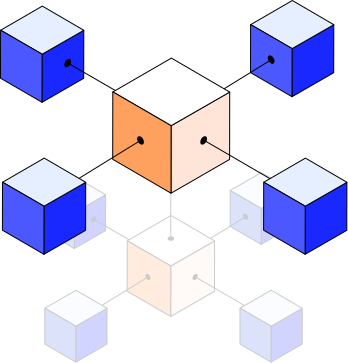
Supply networks are recursive: suppliers of suppliers, parts of parts. Prometheux handles that recursion natively on your tables, so you need no graph database and no hand-written loops, and the same question always returns the same answer.

Any Tier, Any Depth
Recursive rules cover every tier and stop when the chain ends, even when supply links loop back on themselves.

BOMs That Roll Up
Explode an assembly into every sub-part, find every product using a part, and roll up cost as the recursion runs.

Edges From Anywhere
Supplier links in one database, BOMs in another, shipments in Parquet: one rule set reads them all where they are.

A Route Per Answer
Each exposed plant or product links to the supplier path, rules and source rows behind it, ready to share.
See the blast radius of a supplier in one query. Show the plant manager exactly why. Change a sourcing rule once, everywhere.
One Question.
Then the Next.
Connect in Place
Point Prometheux at the systems behind one question: ERP, procurement, PLM, warehouse or transport. The data is processed where it lives; nothing is copied. See in-place data processing.
Codify the Knowledge
Your planners, our forward deployed engineers and the AI assistant turn spreadsheets, policies and expertise into readable rules, such as "a plant depends on every supplier of a supplier it depends on". See recursion.
Run One Use Case
Supplier exposure, a sourcing check, a BOM roll-up or a late-shipment impact, on current data, for teams and agents alike, with the path to each result. See data lineage.
Expand Use Case by Use Case
Each new use case reuses the rules and connections already in place, so the next team starts further ahead.
Questions,
Answered
How does Prometheux find exposure beyond tier one?
With recursive rules. You state the base case (a supplier supplies a plant) and the recursive case (a plant depends on every supplier of a supplier it depends on), and the engine follows the chain to every tier until no new links are found.
Which supply chain questions can Prometheux answer?
Any question you can state as rules over data you hold: supplier exposure at any tier, sourcing and certificate checks, BOM explosion and cost roll-up, stock against policy, and the orders behind a late shipment. The use case menu above lists common starting points.
Do we need a graph database or a new supply chain platform?
No. Prometheux reads supplier, BOM, inventory and logistics tables where they already live, in your ERP, databases, warehouses and files, and runs the rules over them. Nothing has to be loaded into a graph store first.
What if our supply links contain cycles?
Rules are evaluated to a fixed point: once no new facts can be derived, the engine stops. Following a loop in supplier links (who depends on whom) stops once every link has been found; for computed values such as path length, a minimum-style aggregation lets the result settle.
Can we see why a plant, product or order is flagged?
Yes. Every derived result keeps its provenance: the rules that fired and the source rows they used, including each hop of a multi-tier chain.
Can it tell us when exposure changes?
Yes. Rules can run on a schedule or when data changes and write results back, so a new exposure reaches planners or an agent without anyone re-running the analysis.
Does this replace our planning or supplier-risk tools?
No. Risk-intelligence services add outside data on suppliers you may not know about; planning suites model scenarios inside their own platform. Prometheux runs your dependency and sourcing rules on the data you hold, including supplier data you license, and dashboards, planning tools and agents call the results through SQL, the REST API, the Python SDK or MCP.
More Industries
Bring One Supply Chain
Question.
Supplier exposure, a sourcing check, a BOM roll-up or a late shipment on your own data. Our forward deployed engineers will run it with you, in place, on your infrastructure.
