
Same Input.
Same Output.
Prometheux runs your business rules as code over your data, where it lives, and records how each result was derived. The model interprets; the rules decide, so a decision made today can be re-run, checked and defended tomorrow.
Proven in production








Plausible Isn't
Defensible.
When a regulator, auditor or customer asks why, "the model said so" is not an answer. Decisions need to come out the same way twice and show their working.
Rules Decide.
LLMs Describe.
In Prometheux, concepts written in Vadalog, SQL, Cypher or Python are deterministic: the same inputs always produce the same outputs. LLM concepts sit in the same ontology but are explicitly marked as non-deterministic, so you always know which step could vary.


Deterministic Concepts
Vadalog, SQL, Cypher and Python concepts return the same result for the same data, every run.

Cacheable Results
Because outputs are repeatable, results can be cached and re-served without re-computing or re-prompting.

LLMs, Clearly Fenced
LLM concepts are labelled non-deterministic, so the decision path stays in rules and the model handles language.

Data Is Data
Values substituted into prompts are framed as data, not instructions, making prompt injection through your pipeline harder.
Versioned Like Code
With the px CLI, rules live as plain files in git: diff every change, review it in a pull request, and roll back if needed. See context as code.
Re-run any decision and get the same result. Know exactly which steps can vary, and why. Put AI into workflows your risk team will sign off.
Every Result
Has a Receipt
As the engine reasons, it records a derivation for every result: the fact, the rule that produced it and the facts it came from. Keep it as a file or explore it as a graph, and hand it to whoever needs to check the work.

Full Derivation Graph
Records how every output was derived, including through aggregations.

Rule-Level Trace
Each derived fact links to its originating rule and the source facts it used.

Provenance at Scale
The chase graph is materialised in parallel and distributed, alongside the reasoning, as data grows.

Data Stays Put
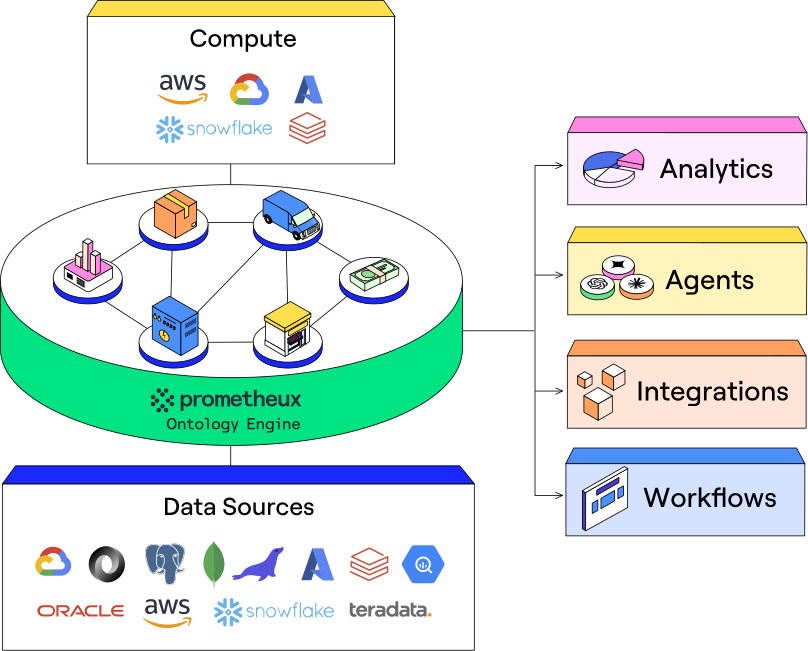
Rules run over your warehouses, lakes and databases in place. No copies to reconcile at audit time.
Answer "why?" in minutes, not weeks. Give auditors the trail, not a reconstruction.
From Policy to
Repeatable Decision
Write the Rules
Express the policy as rules on top of your connected sources, and keep them versioned in git.
Run Deterministically
The engine applies the rules to your data. Same data and rules, same result.
Record the Derivation
The engine stores which rule produced each fact, from which rows.
Add Language Last
If you need a narrative, an LLM concept summarises a result the rules already decided.
Built for Decisions
You Must Defend
Regulatory Credit Flows
Banca Sella explains every credit decision with rules over the client's full history, cutting a regulatory flow from 5 hours to under a minute.
Read the case study →Reproducible Reporting
Re-run a regulatory report months later and get the same figures, with the rule trail behind every line.
Limits and Alerts
Credit limits, supplier risk and fraud flags are computed by rules, not estimated, so thresholds trigger the same way every time.
Governed LLM Use
Keep the decision in deterministic concepts and use an LLM only to explain it, with each step clearly labelled.
Neurosymbolic AI →“Prometheux enabled us to build a system that can access our databases, process all the client's historical variables, and provide an intelligent, understandable explanation autonomously.”
 Massimiliano Malin
Head of Credit Risk · Banca Sella
“With Prometheux, we achieved a speed-up of over 250% on critical tasks involving complex reasoning over knowledge graphs with hundreds of millions of nodes and billions of edges.”
Financial institution
Questions,
Answered
What is deterministic AI?
AI where the decision is produced by explicit rules over data, so the same inputs always yield the same output. In Prometheux, concepts written in Vadalog, SQL, Cypher or Python are deterministic; LLMs are used for language, not for the decision itself.
Will a model update change my results?
Not the decisions. They come from deterministic concepts, so outcomes change only when a rule or the data changes, and provenance shows which. LLM concepts are labelled non-deterministic and kept to language tasks such as summaries.
How do we know which version of a rule made a decision?
Rules can live as plain files in your git repository through the px CLI, so every change has an author, a date and a review. Combined with the derivation recorded for each result, you can show which rules produced a decision and what they looked like at the time.
Can I still use LLMs?
Yes. LLM concepts live alongside your rules and can summarise or explain results. They are explicitly marked as non-deterministic, so you can keep them out of the decision path and know which steps could vary.
Isn't this just a rules engine?
Decision engines typically apply expert rules to one case at a time, on data passed to them. Prometheux runs rules recursively over entire warehouses, lakes and databases in place, across sources, in your cloud or on-premises. It records the derivation of every result, including through aggregations, and agents call the same logic through APIs or MCP.
How do I prove how a result was reached?
Switch on provenance and the engine records a derivation graph linking each result to the rule that produced it and the source data it used. Keep it as a file or explore it as a graph.
Does deterministic mean my data has to be copied somewhere?
No. Prometheux runs rules over your warehouses, lakes and databases where they are, so there is no copy to drift out of sync with the source.
Related Capabilities
Make Your AI
Repeatable
Bring a decision you need to defend. We'll run it as deterministic rules over your own data, with the trail to prove it.
