
Centralize Meaning.
Not Storage.
Keep each store optimized for what it does best. Put one meaning layer over all of them that actually runs: your business rules execute where the data lives, people and agents get the same answer, and every result traces to its source rows.
rules v12 · one rule setProven in production








Every Copy
Is a Liability.
A new lakehouse rarely ends data sprawl. Each extract into it is another dataset to secure, reconcile and explain to an auditor. In-place processing removes the copy.
One Meaning Layer.
Every Store.
You don't need one store to have one truth. Leave each system tuned for its job, whether that's transactions, analytics, files or cost, and centralize what the data means: definitions and rules that run in place, which agents can call and execute rather than just read. Nothing is staged in a Prometheux copy.
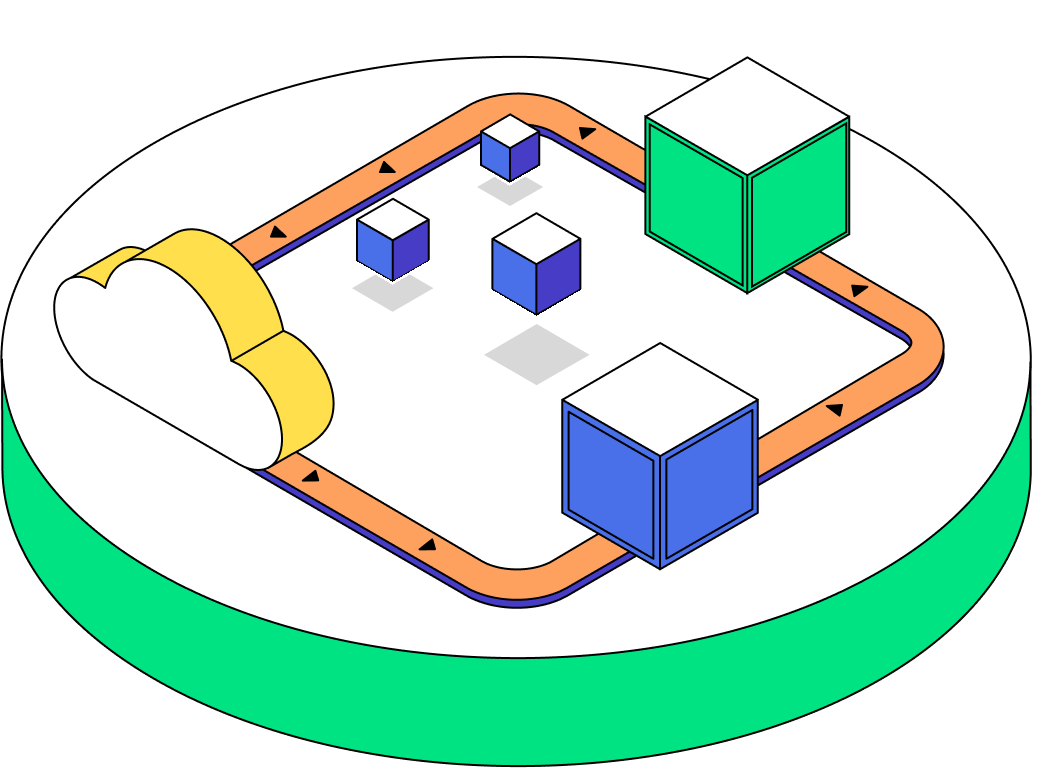

Meaning Agents Can Run
The layer isn't documentation. Agents and apps call its rules and concepts over MCP, REST or Python and get computed answers. See semantic layer.

No Replication
Work directly on existing infrastructure, with no duplicated tables and no sync jobs to babysit.

Runs in Your Environment
Deploy inside your cloud, VPC or on-premises, so data sovereignty and residency stay intact.

Governance Stays Put
On Databricks, processing runs governed by Unity Catalog. Each result keeps lineage to its sources.

Credentials Under Control
Pass connection details as options or keep them in external properties files, out of your rule code.
Say yes to AI projects without a data-movement review. Keep auditors on the controls you already have. Stop paying to store and sync the same data twice.
Process Data
Without Moving It
Deploy Where Data Lives
Run Prometheux in your cloud, VPC, on-premises or natively on Databricks.
Connect to Sources
Connect tables, files and queries in place.
Run the Logic
The engine runs joins, recursion and aggregation as distributed jobs.
Return Only Results
Derived results are served or written back, not staged in a new store.
Built for Data
That Can't Move
Credit Decisions on Live Data
Banca Sella's system reads the client's full history straight from its own databases to explain every credit decision.
Read the case study →Data Residency
Keep data inside the jurisdiction and environment it belongs to, and bring the processing to it.
Sensitive Research Data
Reason over clinical and research sources where they are governed, instead of exporting them to a sandbox.
AI Without Exports
Give agents answers derived from live sources without copying those sources into a vector store or new warehouse.
“Prometheux enabled us to build a system that can access our databases, process all the client's historical variables, and provide an intelligent, understandable explanation autonomously.”
 Massimiliano Malin
Head of Credit Risk · Banca Sella
“The ability to query heterogeneous databases through a flexible ontology makes it possible to infer deep knowledge and automate complex tasks, delivering trustworthy insights that far exceed the capabilities of traditional systems.”
 Anna Fava
Former Senior Manager, Data & AI · Dompé
Questions,
Answered
Does Prometheux copy my data?
No. Prometheux connects to data where it already lives and applies logic at query time. It does not require moving data into a new warehouse or graph database.
Shouldn't we centralize everything in one lakehouse first?
You can, but you don't have to wait for it. Each store can stay optimized for its job while Prometheux centralizes the meaning: one set of business rules that runs in place across all of them. If you do consolidate later, the rules stay the same; you just point them at the new home.
Where does processing happen?
Inside your environment: your cloud, a private VPC, on-premises or natively on Databricks. Prometheux reads each source where it lives and runs the logic itself, as distributed, parallel jobs.
What happens to my existing permissions and governance?
Your data stays in the systems that already govern it. On Databricks, processing is governed by Unity Catalog.
How is this different from data virtualization or federated query engines?
Those put one access layer and shared metadata over many sources. Prometheux also reads in place, but it executes your business rules over the data: reusable definitions, recursive logic, deterministic results with lineage to source rows, and write-back to connected targets that support writing.
Isn't querying in place slow?
Data is read where it lives, with no copy to wait for, and the engine runs joins, recursion and aggregation as distributed, parallel jobs. On Iceberg, partitions and files that can't match a filter are skipped when the read is planned.
Related Capabilities
Centralize Meaning.
Leave the Data.
Tell us where your data lives. We'll show you one meaning layer running over it, in place, for your teams and your agents.
