
Your Data,
Queried as a Graph.
Query the tables, files and APIs you already run as one connected graph. No graph database, no ETL, and nothing to build or keep in sync.
| employee | reports up to | levels |
|---|---|---|
| A. Rossi | CFO | 3 |
| M. Chen | CFO | 2 |
| L. Novak | COO | 4 |
Proven in production








No Graph
to Build.
Most knowledge graph projects start with an export: copy every source into a graph store, then keep that copy in sync. With Prometheux there is no second copy. You describe the graph over the data you have and query it.
Entities and Edges
Over Data in Place
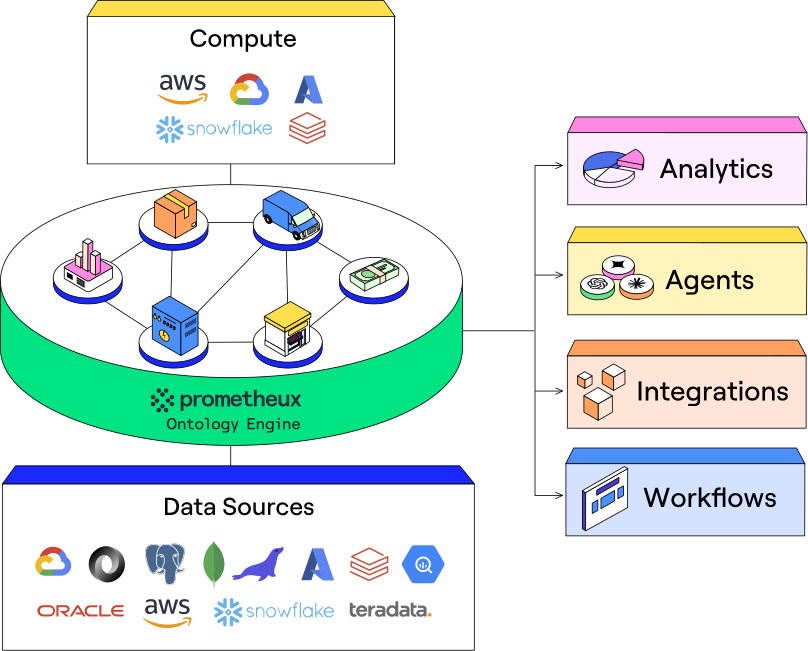
Point entities and relationships at the tables, files and APIs that already hold them. Prometheux reads each source where it lives when you query, so there is no graph store to load and no sync job to run. Add a source and it becomes part of the graph.

Any Source
Postgres, Oracle, Snowflake, Databricks, BigQuery, CSV, Parquet, Iceberg, Neo4j, HTTP APIs and more, queried as one graph.

Declarative Mapping
Map a table or file to an entity, and a key or join to a relationship. Nothing is copied.

Derived Relationships
Rules infer edges such as multi-tier supply, reporting lines or shared devices that no single table contains.

SQL and Graph, One Copy
Query the same data with SQL or Cypher `MATCH` patterns. No graph database required.
Get a cross-source graph without a new database. Add sources without new pipelines. Know where every relationship came from.
Traverse, Analyse,
Reason
Run traversals, centrality, shortest paths and connected components over your data as it stands, write recursive rules that reason across it, or let applications and agents query it through APIs and MCP.

Graph Analytics In Place
Multi-hop queries, shortest paths and connected components on your existing relational infrastructure.

Scales to Billions of Edges
Vadalog Parallel distributes reasoning across clusters and GPUs.

Explainable Edges
The chase graph records which rules and rows produced each derived fact.

Ready for Agents
Expose the graph to apps, the Python SDK and agents through APIs and MCP.
Turn scattered records into connected insight. Answer multi-hop questions in seconds, not projects.
From Tables to
Graph Queries
Connect Sources
Add warehouses, databases, files and APIs as data connections. Nothing is copied.
Define Entities
Declare the entities and relationships of your domain, or have the AI assistant propose them from a prompt or a policy document for you to approve.
Map and Derive
Point each entity at its source and write rules for the relationships to infer.
Query as a Graph
Run graph analytics, Cypher patterns or concepts via API, SDK or MCP.
Graph Questions on
Real Enterprise Data
Biomedical Knowledge Graph
AstraZeneca reasons over compounds, genes and diseases for drug repurposing, accelerated 9× on NVIDIA GPUs.
NVIDIA blog →Fraud Rings
Query customers, accounts, devices and payments as one graph to reveal rings no single table shows.
Graph analytics →Multi-Tier Suppliers
Link ERP, bills of materials and supplier files to see every tier that feeds a product.
Customer 360
Query CRM, billing and support data as one connected view of each customer, without a new store.
“Prometheux technology powers highly scalable and explainable reasoning over some of the world's largest knowledge graphs.”
Accelerating Neurosymbolic AI with RAPIDS and Vadalog Parallel
“The ability to query heterogeneous databases through a flexible ontology makes it possible to infer deep knowledge and automate complex tasks, delivering trustworthy insights that far exceed the capabilities of traditional systems.”
 Anna Fava
Former Senior Manager, Data & AI · Dompé
“With Prometheux, we achieved a speed-up of over 250% on critical tasks involving complex reasoning over knowledge graphs with hundreds of millions of nodes and billions of edges.”
Financial institution
Questions,
Answered
Do I need a graph database?
No. Prometheux queries your existing sources as a graph and runs graph queries and analytics on the infrastructure you already have. There is no graph to build or keep in sync. If you already use Neo4j, it can be one of the sources.
What sources can I query as a graph?
Relational databases such as PostgreSQL, Oracle and SQL Server; warehouses such as Snowflake, Databricks, Redshift and BigQuery; files including CSV, Parquet, Iceberg and Excel; Neo4j, Qdrant and HTTP APIs.
How is this different from loading data into a graph database?
A loaded graph is a second copy that only holds the edges you put in. Prometheux reads the data where it lives and also runs rules over it, so it derives relationships such as multi-tier supply or indirect reporting lines that no source stores explicitly.
Can the graph ground AI agents?
Yes. Agents query graph concepts through MCP or the APIs, and LLM concepts can take graph results as input, so answers rest on rule-derived relationships with lineage rather than text similarity alone.
Can I see why an edge exists?
Yes. Every derived fact is recorded in the chase graph with the rule that produced it and the facts it was derived from.
Can it work with documents?
The AI assistant can ingest a PDF, policy or glossary and propose concepts from it, and it asks for confirmation before changing the schema. Relationships between records are then derived by rules over your connected data, so they are reproducible and traceable.
Related Capabilities
Query Your Data
as a Graph
Bring two or three sources and a question that crosses them. We'll query them as one graph, live, with nothing copied.
