
Hard Logic.
Huge Data.
Prometheux turns readable rules into parallel execution plans, so recursion, multi-hop joins and graph logic run at production scale. The same program runs on a laptop, across a cluster, and on GPUs.
rules v12 · one rule setProven in production








Hand-Tuned Jobs.
Or a Real Engine.
Recursive and multi-hop logic is where hand-written pipeline code and SQL slow down and get fragile. Prometheux plans and parallelises it for you.
Rules In.
Parallel Plans Out.
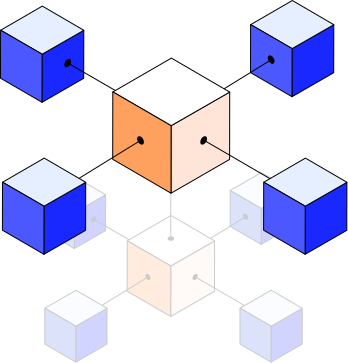
Vadalog Parallel compiles every rule into project, select and join primitives, then runs them as map, filter, reduce and shuffle transformations that run in parallel across a cluster. You describe the logic. The engine decides how to spread it.

Compiled for Parallel Runs
Rules become distributed transformations that run in parallel across your cluster, not row by row in a driver.

Recursion at Scale
Supply chains, org hierarchies and multi-hop dependencies run as recursive rules over graphs with billions of edges.

Read in Place
Iceberg, Parquet and your databases are read where they live, with no copy.

GPU Acceleration
With NVIDIA RAPIDS, Vadalog Parallel ran AstraZeneca's biomedical reasoning 9× faster on GPUs.
Run the logic you avoided because it was too slow. Get results in seconds where batch jobs took hours. Spend engineering time on rules, not tuning.
From Rule to
Cluster in Four Steps
Write the Logic
Express joins, recursion and aggregations as declarative Vadalog rules.
Plan the Execution
The engine turns rules into project, select and join primitives and optimises the plan.
Read Data in Place
Each source is read where it lives, with no load into a new database.
Run in Parallel
The plan executes as distributed transformations on your cluster, locally or on GPUs.
Built for the
Heaviest Workloads
GPU-Accelerated Reasoning
AstraZeneca reasons over millions of compound, gene and disease data points, 9× faster with RAPIDS and Vadalog Parallel.
NVIDIA blog →Billion-Edge Graphs
A financial institution sped up critical reasoning tasks by more than 250% on graphs with hundreds of millions of nodes.
Graph analytics →Network Risk
Fraud rings and multi-tier supplier risk need recursion over the whole network. The engine runs it in parallel instead of in nightly batches.
Recursive Pipelines
Hierarchies, bills of materials and lineage graphs stop being special cases. They are a few rules the engine scales for you.
“With Prometheux, we achieved a speed-up of over 250% on critical tasks involving complex reasoning over knowledge graphs with hundreds of millions of nodes and billions of edges.”
Financial institution
“Prometheux technology powers highly scalable and explainable reasoning over some of the world's largest knowledge graphs.”
Accelerating Neurosymbolic AI with RAPIDS and Vadalog Parallel
Questions,
Answered
How does Prometheux execute at scale?
The engine compiles rules into project, select and join primitives, then runs them as map, filter, reduce and shuffle transformations in parallel across a cluster.
Where can the engine run?
On Databricks (as a native app or installed on your clusters), on self-managed Kubernetes, or in local mode for development and testing.
Do I need new infrastructure?
No. The engine runs on your existing Databricks clusters, on Kubernetes, or locally. There is no new database to load data into: it reads Iceberg, Parquet and your existing systems in place, and the engine runs the logic as distributed jobs.
Does it support GPUs?
Yes. Vadalog Parallel with NVIDIA RAPIDS accelerated AstraZeneca's neurosymbolic reasoning 9× on GPUs, as described on the NVIDIA Technical Blog.
Is it faster than PySpark?
For complex and recursive processing, Prometheux outperforms optimized PySpark, because recursion, planning and parallel execution are handled by the engine instead of hand-written loops.
How is this different from a fast analytical database?
Analytical databases are built to scan and aggregate quickly. Prometheux is built for the logic that SQL handles badly: recursion to any depth, multi-hop joins and graph rules, planned and parallelised by the engine, with deterministic results.
Related Capabilities
Bring Your
Slowest Job
Share the query that takes hours today. We'll show you how it runs as rules on the Prometheux engine.
