
Many Databases.
One Program.
Answer questions that span Postgres, Snowflake, Databricks, Neo4j and files without copying a table. One set of rules reads from all of them, recurses across them and writes back to any of them, and every result traces to its source rows.
customer_360✓churn_signals✓at_risk_accounts✓Proven in production








N Systems.
N Languages.
The questions that matter rarely live in one database. Answering them usually means a pipeline per source, a copy in a central store and a reconciliation job at the end. Federated SQL removes the copy, but not the logic gap.
Query It All
As One System
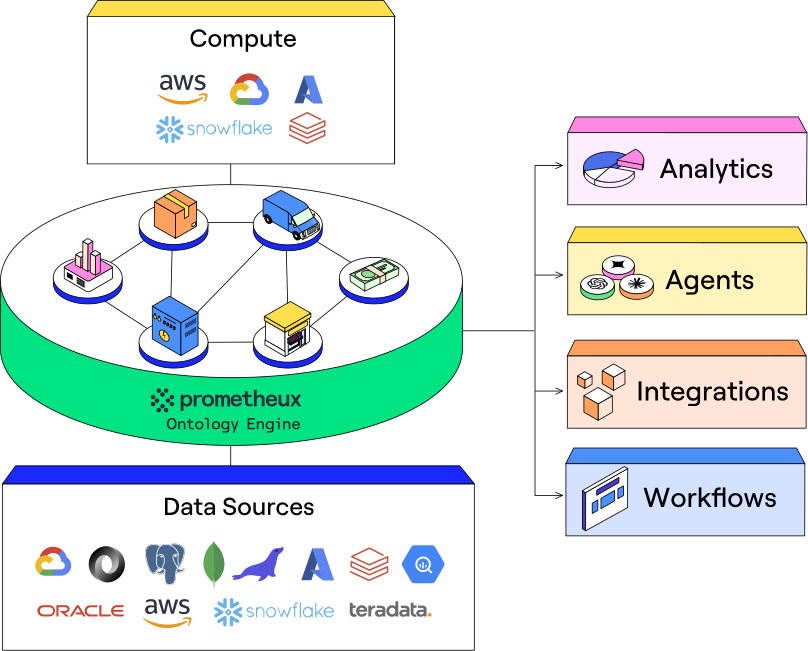
Every source is connected to a predicate. From there, rules join them freely: a customer table in Postgres, transactions in Snowflake, a relationship graph in Neo4j, a reference file in object storage. The engine reads each source where it lives and runs the joins, recursion and aggregation itself, as distributed jobs.

Broad Connector Set
Relational databases, Snowflake, Databricks, BigQuery, Redshift, Iceberg, Parquet, Neo4j, Qdrant and HTTP APIs.

Read and Write Together
Read from several systems and write results to another, from the same program.

The Engine Does the Work
Joins, recursion and aggregation across sources run in the Prometheux engine.

One Shared Model
Sources map into one shared model, so 'Supplier' means the same thing whichever system the row came from, and agents query it over MCP.
Answer cross-system questions in one place. Retire the glue jobs between your databases. Give teams one language for every source.
Join Across
Sources in Minutes
Connect Each Source
Connect each table, file or query, whatever system it lives in.
Map to Concepts
Align them to shared entities in your model.
Write Cross-Source Rules
Join, filter and aggregate across systems in ordinary rules.
Write Where You Need
Send results to any connected target, or serve them via API.
Questions That
Span Systems
Heterogeneous Research Data
Query heterogeneous research databases through one flexible model instead of reconciling them by hand.
Customer 360 Risk
Combine core banking tables, warehouse history and transaction graphs to see the whole customer.
Relational Meets Graph
Join Neo4j relationships with warehouse facts in one rule, without copying either side.
Cross-Team Reporting
Build one report from systems owned by different teams, without a new central store.
“The ability to query heterogeneous databases through a flexible ontology makes it possible to infer deep knowledge and automate complex tasks, delivering trustworthy insights that far exceed the capabilities of traditional systems.”
 Anna Fava
Former Senior Manager, Data & AI · Dompé
“Prometheux enabled us to build a system that can access our databases, process all the client's historical variables, and provide an intelligent, understandable explanation autonomously.”
 Massimiliano Malin
Head of Credit Risk · Banca Sella
Questions,
Answered
Which databases can I combine?
Any documented connector: PostgreSQL, MySQL, MariaDB, Oracle, SQL Server, DB2, Teradata and more; Snowflake, Databricks, BigQuery, Redshift, Hive, Presto, DynamoDB; files such as CSV, Parquet, Iceberg and JSON; Neo4j, Qdrant and HTTP APIs.
Do I have to move or copy data first?
No. Each source is connected where it lives and queried in place. Nothing is staged in a new central store unless you choose to write results there.
Can I write results back, not just read?
Yes. Connectors support reading and writing, so one program can read from several systems and write to another.
Is a cross-database join efficient?
Each source is read where it lives, with no copy to build first, and the engine runs the joins as distributed, parallel jobs.
How is this different from data virtualization or a federated SQL engine?
Those give you one SQL access layer, often with a semantic layer on top. Prometheux also executes the logic: recursive and graph rules across sources, definitions that are runnable rules rather than descriptions, deterministic results with lineage to source rows, and writes to any connected target.
Can AI agents use it?
Yes. Agents call the same rules through MCP, the REST API or the Python SDK, so their answers come from your definitions, computed the same way every time.
Related Capabilities
Join What You
Couldn't Before
Name two systems that never talk to each other. We'll query them as one.
