
Ask the AI Why.
Get the Trail.
A trace shows which calls your agent made. AI lineage follows the answer further: through the LLM step that wrote it, the context it was given and the rules that fed it, to the source rows underneath.
Proven in production








Chatbots Cite.
Lineage Proves.
A trace shows which calls an agent made. A citation lists a few documents. Neither shows which governed data and which rules sat behind the answer. AI lineage records what each model step received and where its inputs came from.
The Model Is a
Node, Not a Void
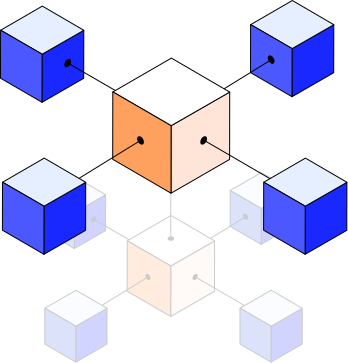
In Prometheux an LLM call is configured as an LLM concept. It sits in the ontology graph like any other concept, with its upstream dependencies visible on the lineage canvas and its output flowing downstream.

Declared Inputs
The prompt pulls in upstream concepts by name with {{concept}} references, so every input to the model is explicit.

Context You Can Cite
Static context pins approved notes; dynamic context records the query. Both return each note's id, source and date.

Model on Record
Provider and model are set per LLM concept, so you know which model produced which output.

Generated, and Labelled
LLM concepts are not deterministic. Treat their output as model-generated text, and keep exact figures in deterministic concepts.
Answer 'why did the AI say that?' with evidence. Separate what was generated from what was derived.
From Sentence
to Source Row
Behind the LLM step sit deterministic concepts. Their results carry chase provenance and explanations, so the trail runs from the generated sentence to the rules that fired and the rows they used.

Derived Facts, Explained
@explain returns each derived fact with a hierarchical JSON derivation and a textual explanation.

Business-Language Narratives
Business descriptions on your model turn raw results into domain sentences, such as 'since Alice is an employee, then Alice is a manager'.
Give reviewers the full chain, not a summary. Keep AI answers defensible end to end.
Following an
AI Answer Back
Start at the Answer
Open the LLM concept that produced the text, with its prompt, model and settings.
See What It Was Given
Check the context notes and upstream concepts it referenced, and whether anything was trimmed.
Step Into the Logic
Follow upstream concepts on the lineage canvas to the rules that computed their results.
Land on the Rows
Provenance and explanations show the exact source facts behind each derived value.
When Someone
Asks Why
Explanations With Lineage
Banca Sella generates natural-language explanatory comments on credit risk, with end-to-end data lineage behind them.
Read the case study →Reviewable AI Summaries
Reviewers see which notes and figures a summary was built from, and which parts the model wrote.
Answers From Approved Sources
Static context pins the documents an LLM step may use, so answers trace back to agreed definitions.
Agent Answers With a Trail
Agents call your concepts via APIs or MCP, so each answer links back to the concepts behind it.
Power AI →“Prometheux enabled us to build a system that can access our databases, process all the client's historical variables, and provide an intelligent, understandable explanation autonomously.”
 Massimiliano Malin
Head of Credit Risk · Banca Sella
“Prometheux technology powers highly scalable and explainable reasoning over some of the world's largest knowledge graphs.”
Accelerating Neurosymbolic AI with RAPIDS and Vadalog Parallel
Questions,
Answered
What is AI lineage?
AI lineage traces an AI-generated answer back through the model step that produced it, the context and upstream data it was given, and the rules and source rows behind that data. It answers 'why did the AI say this?'.
How is AI lineage different from data lineage?
Data lineage traces deterministic results to the rules and source rows that derived them. AI lineage adds the generative layer on top: which LLM step, prompt, model and context notes were involved, and where the deterministic trail begins underneath.
How is this different from LLM tracing or model documentation?
Tracing tools record each call, step and score in an agent run, and model documentation describes a model. AI lineage answers a different question: why this answer. It links one generated answer to the declared inputs of the LLM step, the context notes it used and, through deterministic concepts, the rules and source rows underneath. The two work well together.
Are LLM outputs deterministic?
No. LLM concepts can return different answers on a rerun, and Prometheux treats their output as model-generated. Facts that must be exact are derived by deterministic concepts with full provenance.
Can I see which documents an LLM step used?
Yes. Context concepts return each note's id, kind, title, text, source, creation date and folder path.
Related Capabilities
Trace Your AI
Back to the Source
Bring an AI answer your team has to defend. We'll show you the full trail behind it.
