
Trusted Agents for
Manufacturing
Prometheux turns what your engineers, planners and quality teams know into rules that run on MES, ERP, PLM, quality, maintenance and supplier data where it already lives. Leaders get faster answers on yield, uptime, cost and supply resilience, from the plant floor to products in the field, and every answer comes with the evidence behind it. No new data platform to fill, no risky migration.
Proven in production








The Data Exists.
The Answers Don't.
Production, quality, maintenance, engineering and supply each run their own systems, and the knowledge that connects them sits with a few experts. Prometheux codifies that knowledge once and runs it across every system, for every team.
Where Manufacturing Teams
Start
Pick the area that costs your plant the most today. Each use case runs on the same rules and connections, so the next one starts further ahead.
Production & Quality
Fewer defects and faster root cause, using the data your MES and quality systems already hold.
Maintenance & Assets
Less unplanned downtime by putting maintenance where the line depends on it most.
Product & Service
Close the loop from products in the field back to engineering and the plant that built them.
Supply & Planning
Fewer stockouts and late orders, with supply risk visible before it reaches the line.
The Questions Other
Tools Can't Answer
Batch and Lot Genealogy at Any Depth
Which finished batches contain material from this suspect lot, through every intermediate lot and sub-assembly? A recursive walk, forwards for recall scope or backwards for cause, with every link cited.
BOM Roll-Ups and Where-Used
What does this assembly cost, summed through every BOM level, and which products use a part that just failed inspection? See recursion.
Failure Cascades Across the Line
If this machine goes down, which machines, lines and orders stop with it, directly or several steps downstream? Recursion over dependencies, the same way every run.
Root Cause Across Systems
A failed batch traced through MES steps, the machine that ran them and the ERP lots that fed them, with the quality checks behind each step. See data lineage.
One Model Across
Every Line
Typical industrial data platforms load plant data into their own foundation and add agents on top. Prometheux sits between your plant systems and the people, tools and agents that act on them, and runs the rules where the data already lives.

Analytics
Plant dashboards, graph and BI

Integrations
Back into the databases behind MES, ERP, PLM and maintenance

Agents
Plant agents, deterministic answers

Models
Define the ontology, read answers, and power analytics, integrations and agents


Your plant data
Batches, orders, lots, BOMs, quality checks, sensor history and work orders, connected in place. Nothing to migrate.
-

Plant Operations
- Quality, maintenance, engineering and planning use cases on one set of plant rules
- Agents call deterministic plant rules over MCP and API, with the derivation behind every answer
- Results written back to the databases behind MES, ERP, PLM and maintenance systems, on a schedule or when data changes
-

The Plant Rules Engine
- One model of machines, steps, batches, lots, parts, orders and suppliers across lines and sites
- Recursion with aggregation and graph algorithms: lot genealogy, BOM roll-ups, failure cascades, supplier tiers, PageRank criticality
- Same input, same output, with lineage to the rules and source rows
-

Cloud Agnostic
- Run in your cloud, on your own servers next to the plant, or in Prometheux cloud
- Scale horizontally on clusters as sensor and batch history grows, with optional GPU acceleration
- 1-click deployment anywhere: EKS, AKS, GKE, Databricks Clusters, Snowpark Containers
-

Plant-Data Agnostic
- Read and write MES, ERP, PLM, quality and maintenance data in any database, format and schema
- Connect databases, data lakes, warehouses, files and APIs across clouds and on-premises
- No new data foundation to migrate into and keep in sync
Same Layers.
Better Built.
Map a typical industrial data platform to Prometheux and the difference is where the work happens: in place, in rules you own, with an answer every team can check.
Plant Knowledge.
Owned and Explained.
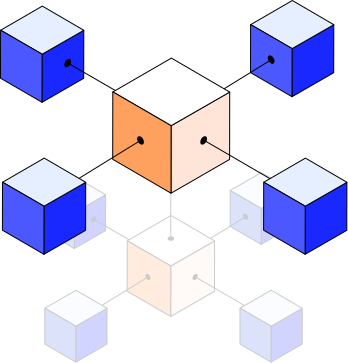
What your engineers and planners know about how machines, steps, lots, parts and suppliers connect becomes rules that run on live plant data. Production, quality, maintenance, engineering and supply get the same answer, and so do the agents and apps built on top.

Owned, Not Vendor-Bound
Plant rules span lines, sites and systems and stay with you, in rules your engineers can read, review and version.

Deterministic and Explained
The same question gives the same answer, from a failed batch to a BOM roll-up, with the rules and source rows behind it, ready for a quality review or an audit.

Built for Plant Scale
Rules run as distributed, parallel jobs, with optional GPU acceleration, over years of batch and sensor history. See high-performance engine.

Portable by Design
Run in Prometheux cloud, your cloud, or on your own servers next to the plant. See on-premises.
Codify plant knowledge once. Reuse it for quality, maintenance, engineering and supply. Give agents rules they can be trusted on.
One Line.
Then the Next.
Connect in Place
Point Prometheux at the systems behind one use case: MES, ERP, PLM, quality or maintenance data for one line or site. The data is processed where it lives; nothing is copied.
Codify the Knowledge
Your engineers and planners, our forward deployed engineers and the AI assistant turn process knowledge, specs, BOMs and planning logic into readable rules in days, not months.
Run One Use Case
Root cause, lot genealogy, failure cascade, BOM roll-up or orders at risk, on live data, for engineers, planners and agents alike.
Expand Line by Line
Each new line, site or use case reuses the rules already written, so coverage grows without rebuilding the model for every tool.
Questions,
Answered
Is this another data platform or digital twin we have to fill?
No. Prometheux reads your MES, ERP, PLM, quality and maintenance data where it already lives, across clouds and on-premises, and runs the rules there. The plant model is logical: there's nothing new to migrate or keep in sync.
We already have an MES, ERP, historian and BI. What does this add?
Keep them. Each one answers questions inside its own system. Prometheux adds the reasoning across them: following a failed batch through steps, machines and lots, a part through every BOM level, or an order back to the machines and suppliers it depends on, and writing results back to the tools your teams already use.
Our machines, parts and suppliers are named differently in every system. Does that block us?
No. You define the machine, part or supplier once and map each system's labels to it in rules, without changing the source databases. Matches can also be resolved by rule, with evidence. See entity resolution.
Can agents act on the plant?
Agents call deterministic rules over MCP or the API and get an answer with its derivation, with the same access rights as the user they act for. Holds, work orders and schedule changes go through your existing systems and approvals, with the evidence attached.
Can it run next to the plant?
Yes. Install it on your own servers with Docker or Kubernetes, in your private cloud, or inside Snowflake and Databricks, under your existing access controls. Prometheux is SOC 2 Type II certified.
What does it cost across our sites?
It depends on your data and use cases, so we measure it on yours rather than quote a generic figure. Most teams start with one line or use case, prove the value, then add use cases on the same rules and connections.
Related Capabilities
Bring One Plant
Use Case.
Root cause, lot genealogy, failure cascade, BOM roll-up or orders at risk, on your own data. Our forward deployed engineers will run it with you, in place, on your infrastructure.
