
Recursion,
Written as Rules
Get the full chain, not the first level. Supply chains, org hierarchies and bills of materials are recursive by nature, so Prometheux runs recursion with aggregation as a few readable rules: no hop limit, no hand-written loop, totals that roll up as it goes.
Proven in production








Loops Break.
Rules Converge.
SQL, pipeline code and graph query languages can all recurse, but only with workarounds. The logic ends up in orchestration code or bounded path patterns that nobody wants to touch when the hierarchy changes.
Say What It Means.
Not How to Loop.
A recursive rule states a definition, such as "a plant depends on every supplier of a supplier it depends on". Prometheux works out the iteration, runs it in parallel and keeps going until the answer is complete.

Base and Recursive Cases
Two or three rules capture what used to take a loop, a temp table and a convergence check.

Aggregates Inside Recursion
msum and mmax let totals build up as the recursion runs, such as the total cost of a bill of materials.

Mutual Recursion
Rules can lead back to themselves through other rules, so layered definitions stay small and reusable.

Reason Over Gaps
Existential rules can posit facts that aren't stored yet, such as an unnamed intermediate supplier, and keep reasoning.
Replace orchestration code with definitions. Change a hierarchy rule once, everywhere. Hand reviewers logic they can actually read.
Deep Chains,
Real Data
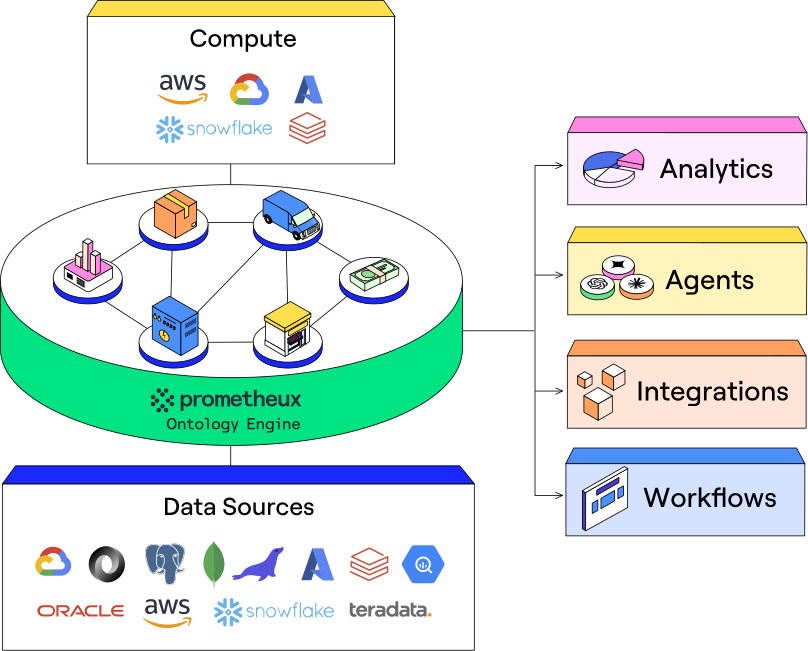
Recursive rules run over the sources you connect, from warehouse tables to Parquet files. Results are new relations that other rules, SQL queries, APIs and agents can use directly.

Supply Chains
Which plants depend on this supplier, at any tier? A classic recursive question, solved in two rules.

Hierarchies
Roll up org charts, cost centres, product categories or approval chains to any level.

Bill of Materials
Explode an assembly into every sub-part, or find every product that contains a given component.

Beyond Cypher
Cypher handles patterns; recursive reasoning runs in Vadalog rules on top of the patterns' results.
Answer the full-chain question, not the first level. Keep data where it is while you recurse over it. Serve recursive results to apps and agents.
From Hierarchy
To Full Answer
Connect the Relationships
Connect the tables that hold supplier, reporting or part-of links. Nothing is copied.
Write Two Rules
State the base case and the recursive case. Add aggregates if totals build along the chain.
Get the Closure
The engine derives every fact that follows, with the rules and rows behind each one.
Recursive Problems,
Everyday Stakes
Fraud Rings
Follow payments between accounts any number of hops to find rings that no single transfer reveals.
Finance & banking →BOM Explosion
List every sub-component of a product, or every product affected by a recalled part, from the BOM tables you already keep.
Manufacturing →Group Structures
Roll exposures and policies up through broker, agency and group hierarchies without rewriting pipelines when they change.
Insurance →Rooted in Datalog
Vadalog comes from peer-reviewed work on recursive reasoning with Oxford, TU Wien and Banca d'Italia.
Browse the papers →“With Prometheux, we achieved a speed-up of over 250% on critical tasks involving complex reasoning over knowledge graphs with hundreds of millions of nodes and billions of edges.”
Financial institution
“Prometheux technology powers highly scalable and explainable reasoning over some of the world's largest knowledge graphs.”
Accelerating Neurosymbolic AI with RAPIDS and Vadalog Parallel
Questions,
Answered
What is a recursive rule?
A rule whose definition leads back to itself, directly or through other rules. It has a base case from your data and a recursive case that builds on it, like "a plant depends on every supplier of a supplier it depends on".
How is this different from a recursive CTE?
Recursive CTEs work for simple chains, but most SQL engines don't allow aggregation inside the recursive step and the logic gets hard to reuse. Vadalog supports monotonic aggregates such as msum inside recursion, and rules compose across programs.
Why not a loop in PySpark?
A loop needs hand-written joins, a temp table and a stop condition for each hierarchy. In Vadalog you write the definition and the engine handles iteration and parallel execution.
What about cycles in my data?
Rules are evaluated to a fixed point: once no new facts can be derived, the engine stops. Following a loop in supplier or reporting links (who depends on whom) stops once every link has been found; for computed values such as path length, a minimum-style aggregation lets the result settle.
Can Cypher do recursion in Prometheux?
Cypher handles pattern matching, including variable-length paths. Recursive reasoning runs in Vadalog rules, which can consume the results of your Cypher patterns.
How is this different from variable-length paths in a graph query?
A variable-length pattern finds routes; totals and conditions are applied afterwards, and long unbounded patterns can multiply. A recursive rule states the definition, aggregates such as msum accumulate as it runs, and evaluation stops at a fixed point. Every derived fact is traceable to its rules and rows.
Related Capabilities
Turn Your Deepest
Hierarchy Into Rules
Bring a recursive problem you solve with loops today. We'll write it as rules on your own data.
